


Ninja used to be the cheap answer to this question. It isn't any more. The Luxe Café Premier is $599.99, the AutoBarista Pro is $949.99, and the range now runs past both of its rivals at the top end.
That reframes the comparison. De'Longhi, Breville and Ninja are no longer three price tiers. They're three different ideas about what a coffee machine should do, sold at overlapping prices, and the right one depends on how much of the process you want to own.
What Each Brand Is Built to Do
De'Longhi builds super-automatics. You press a button and the machine grinds, doses, tamps, brews and ejects the puck. The Magnifica Evo is $749.95 and has no portafilter at all, which is the entire design philosophy in one omission.
Breville builds semi-automatics for people who want to pull a shot. The Barista Express is $699.95, grinds into a 54mm portafilter at an 18g dose, and leaves tamping and timing to you. Its Thermocoil system with PID temperature control holds water at 200°F, which is the technical argument for the whole brand.
Ninja builds multi-function machines. The Luxe Café Premier is a "3-in-1 versatility" system covering espresso, drip coffee and rapid cold brew from one countertop unit, and Ninja now also sells the AutoBarista super-automatic. The bet is that most households want several drinks from one appliance rather than one drink done perfectly.
De'Longhi vs Breville vs Ninja at a Glance
| Feature | De'Longhi Magnifica Evo | Breville Barista Express | Ninja Luxe Café Premier |
|---|---|---|---|
| Price | $749.95 | $699.95 | $599.99 |
| Type | Super-automatic | Semi-automatic | 3-in-1 espresso, drip, cold brew |
| Portafilter | None | 54mm, 18g dose | Yes |
| Grinder | Conical burr, 13 settings | Conical burr, 16 settings | Integrated |
| Temperature control | Not published | Thermocoil with PID at 200°F | Not published |
| Drip coffee | No | No | Yes |
| Cold brew | No | No | Yes |
| Milk | Manual steam wand | Manual steam wand | Milk system |
| Warranty | 2 years, 3 with registration | 1 year limited | 1 year limited |
| Range | $649.95 to $1,099.95 | Bambino to Oracle | $279.99 to $949.99 |
Bottom line: Buy De'Longhi if you want espresso with no technique. Buy Breville if the making is the point. Buy Ninja if the household drinks drip and cold brew as much as espresso and you'd rather own one machine than three.
De'Longhi: Espresso Without the Technique
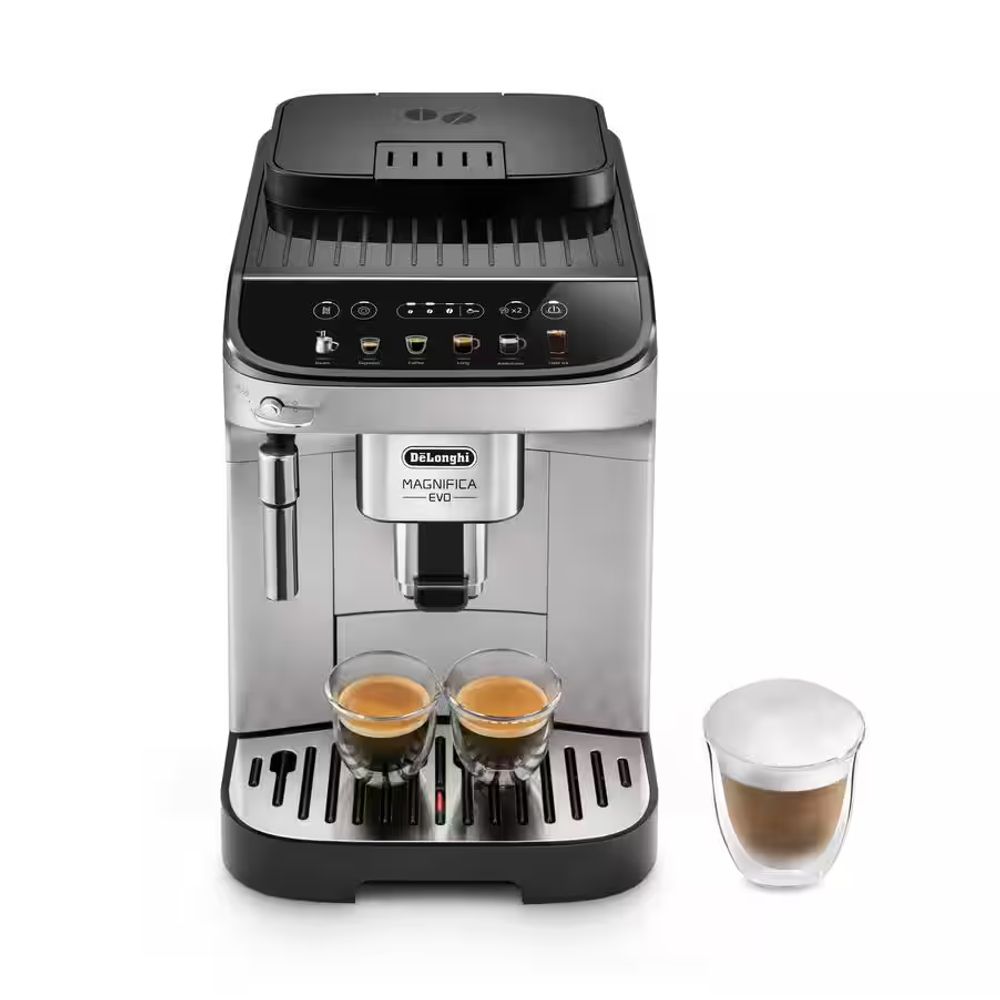
Magnifica Evo Espresso Machine (ECAM29043SB)
$749.95. A bean-to-cup super-automatic with a 13-setting conical burr grinder and a manual steam wand.
Shop NowDe'Longhi is the volume leader in super-automatics and markets the Magnifica Evo as the "#1 Super Automatic Espresso Maker in the US," a claim it footnotes to Circana retail tracking unit share for January to December 2025. That's a sales position rather than a quality verdict, but it tells you where the brand's centre of gravity sits.
The Magnifica Evo is $749.95 with a conical burr grinder offering 13 settings and a traditional manual steam wand. Beans go in the hopper, water in the tank, and every drink from espresso to americano is one button away. Puck disposal is automatic into an internal bin.
The range gives you room to move. The Magnifica Start is $649.95, the Magnifica Evo with LatteCrema System is $899.95 if you want milk automated too, and the Magnifica Evo Next is $1,099.95.
The limitation is control. A super-automatic decides the extraction variables for you, which is the point and also the ceiling. You can change grind and volume, but you can't chase a specific shot.
Best for: Households where several people want different drinks quickly and no one wants to learn a technique.
Breville: The One That Teaches You
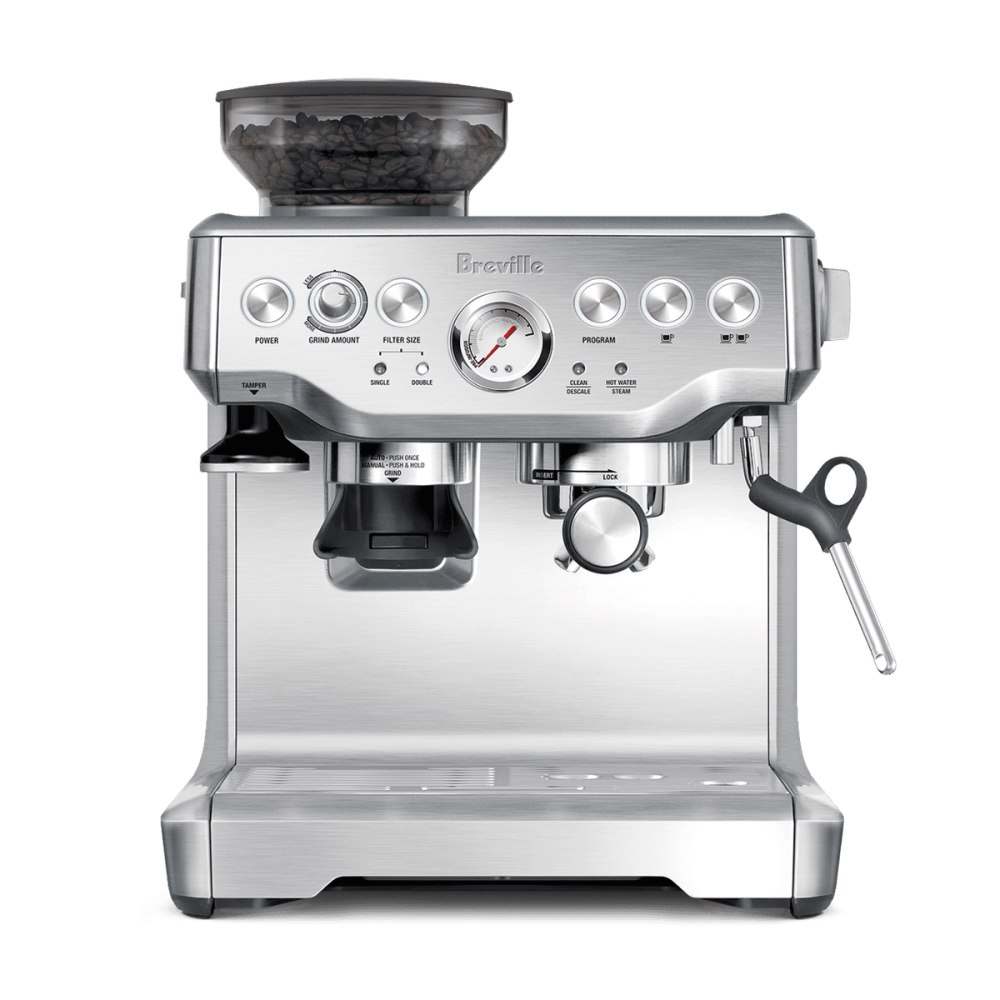
the Barista Express (BES870XL)
$699.95. A semi-automatic with a 16-setting burr grinder, 54mm portafilter and PID temperature control at 200°F.
Shop NowBreville has been the default first espresso machine for over a decade, and the Barista Express at $699.95 explains why. It pairs an integrated conical burr grinder with 16 settings to a 54mm stainless portafilter targeting an 18g dose, then runs "low pressure pre-infusion followed by 9 bar extraction" through a 15 bar Italian pump.
The detail that matters most is heat. Breville uses a "Thermocoil heating system with PID temperature control" that it says "delivers water at exactly 200°F." Espresso is unforgiving about brew temperature, and neither De'Longhi nor Ninja publishes a comparable figure for these machines. That's the strongest technical claim any of the three makes.
The cost is effort. You tamp every shot, knock out the puck yourself, and spend the first couple of weeks dialling in grind size before shots stop running fast or choking. Breville lists a Distribution Duo 54mm at $109.95 and a Knock Box 10 at $33.95 as usual companion purchases, so budget past the sticker.
What you get is headroom. Better beans, a finer grind and a better tamp all show up in the cup in a way they can't on a machine that decides for you.
Best for: One or two drinkers who find the process satisfying and want a ceiling to climb toward.
Ninja: Three Machines in One Box
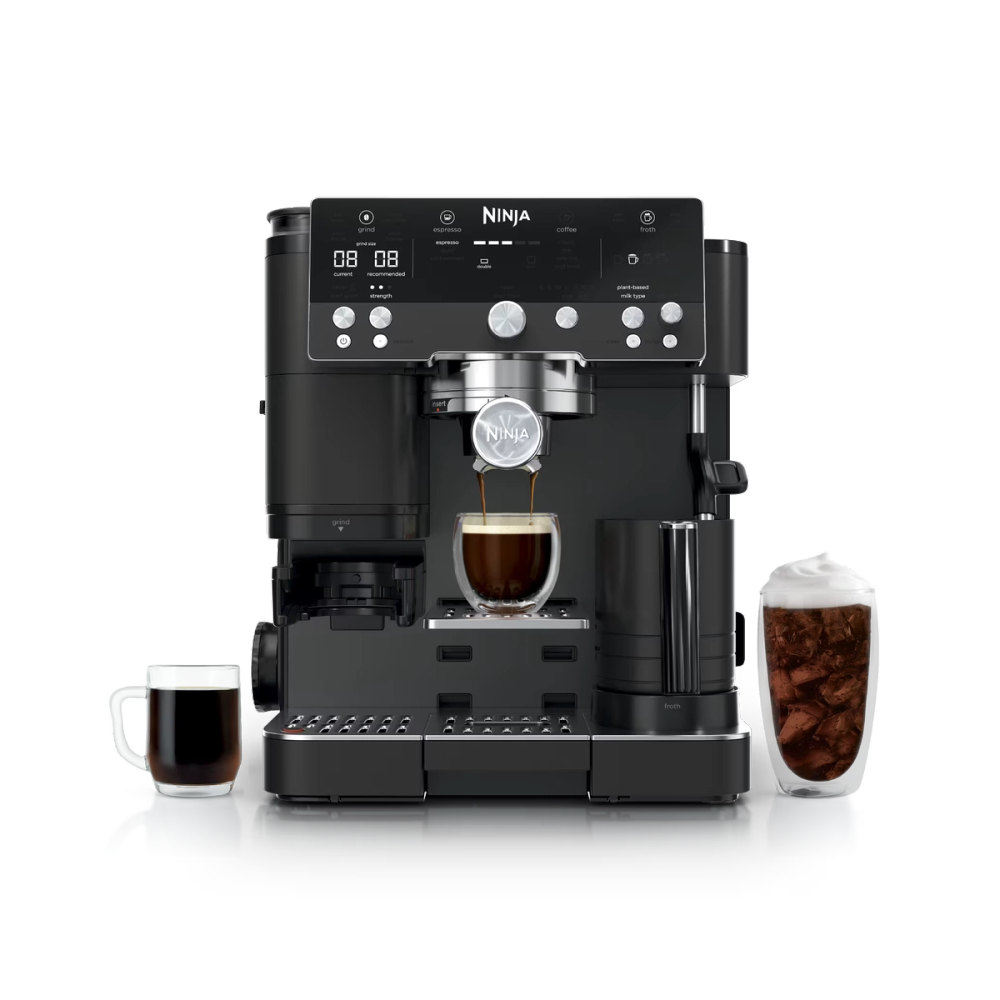
Luxe Cafe Premier Espresso Machine (ES601BK)
$599.99. A 3-in-1 system covering espresso, drip coffee and rapid cold brew, rated 4.2 across 820 reviews.
Shop NowThe Luxe Café Premier is $599.99 and undercuts both rivals while doing more. Ninja describes it as an "intelligent espresso & coffee system with 3-in-1 versatility," covering espresso, drip coffee and rapid cold brew from one unit. It carries 4.2 stars across 820 reviews.
That versatility is the real argument. A Barista Express makes espresso and nothing else, and so does a Magnifica Evo. If your household drinks a pot of drip on weekday mornings and espresso at weekends, Ninja replaces two appliances and saves counter space doing it.
The range has also grown past its budget reputation. The Espresso & Coffee Barista System starts at $279.99, the Luxe Café Mini is $449.99, the Luxe Café Pro is $749.99, and the AutoBarista Pro is $949.99, which is a super-automatic aimed squarely at De'Longhi's territory and priced above the Magnifica Evo.
Ninja backs the Luxe Café Premier with a one-year limited warranty, which sounds like the catch until you check the others. Breville lists the same one-year limited warranty on the Barista Express. De'Longhi is the outlier here, offering two years on the Magnifica Evo and a third year with product registration.
Best for: Households that drink drip and cold brew as well as espresso, and want one machine to do all three.
Which Makes the Best Espresso?
Breville, on the espresso specifically, and the reason is temperature control.
PID regulation holding water at 200°F is a genuine technical advantage, and it's the one spec here that maps directly to shot quality. Dialled in well, a Barista Express shot should beat both rivals. Dialled in badly it's worse than either, because the machine gives you enough control to get it wrong.
De'Longhi wins on consistency rather than peak quality. The Magnifica Evo lands in a narrow band every time with no skill required, which is why it suits a household rather than an enthusiast.
Ninja isn't trying to win this particular contest. Its espresso is one of three functions rather than the whole purpose, and the 3-in-1 design is a breadth argument, not a depth one.
None of the three automates milk at these price points. All use a manual steam wand or milk system you operate yourself, so latte art is a skill you're learning regardless. De'Longhi's auto-frothing LatteCrema version is $899.95 if that's the gap you want closed.
Does the Price Gap Matter?
Less than the format difference does.
The three machines here span $599.99 to $749.95, a $150 spread on appliances that work in fundamentally different ways. Choosing on that gap is choosing on noise. A super-automatic and a semi-automatic are not two grades of the same product.
The prices that matter are the ones bracketing each range. Ninja starts at $279.99 and reaches $949.99. De'Longhi runs $649.95 to $1,099.95. Breville spans the small Bambino up to the Oracle. Each brand has a machine above and below the one compared here, so pick the format first and the price second.
Which Should You Buy?
Buy De'Longhi if mornings are rushed, more than one person makes coffee, and tamping sounds like a chore. It's the machine that keeps working when no one wants to think.
Buy Breville if you want to make espresso rather than obtain it. PID temperature control and a 54mm portafilter give you real levers, and the machine rewards attention the other two structurally can't.
Buy Ninja if espresso is one of several things you drink. At $599.99 it's the cheapest of the three and the only one that also makes drip and cold brew. Its one-year warranty matches Breville's, so that isn't the compromise it looks like.
Five Things to Know Before You Choose
Ninja is no longer the budget option
The Ninja espresso range runs from $279.99 to $949.99, and the AutoBarista Pro at $949.99 sits above every De'Longhi model compared here. Treating Ninja as the cheap pick is out of date.
De'Longhi has the warranty advantage, not Breville
De'Longhi covers the Magnifica Evo for two years and adds a third with product registration. Breville and Ninja both list a one-year limited warranty, so the $699.95 machine and the $599.99 one are covered for the same period.
None of them froths milk for you
All three use a manual steam wand or milk system at these prices. Automating the espresso doesn't automate the cappuccino. De'Longhi's auto-frothing LatteCrema version is $899.95.
Only Breville publishes a brew temperature
Breville states PID control at exactly 200°F. Neither De'Longhi nor Ninja publishes a comparable figure for these models, which makes it the one directly comparable quality spec on the table.
Budget past the sticker on the Breville
Breville lists the Distribution Duo 54mm at $109.95 and the Knock Box 10 at $33.95 as usual companion purchases. A semi-automatic realistically costs more than its box price.
Frequently Asked Questions
Is Ninja as good as De'Longhi or Breville for espresso?
For espresso alone, no. Breville offers PID temperature control at 200°F and a 54mm portafilter, and De'Longhi delivers more consistent automated shots. Ninja's Luxe Café Premier at $599.99 trades some espresso depth for drip coffee and cold brew in the same unit, which is a different proposition rather than a worse one.
Which is cheapest, De'Longhi, Breville or Ninja?
Ninja at $599.99, against $699.95 for the Breville Barista Express and $749.95 for the De'Longhi Magnifica Evo. Across full ranges Ninja also has the lowest entry point at $279.99, though its AutoBarista Pro reaches $949.99 at the top.
What is the difference between a super-automatic and a semi-automatic?
A super-automatic grinds, doses, tamps, brews and ejects the puck in one cycle, so there's no portafilter. A semi-automatic controls pressure and temperature but leaves preparation to you: you dose into a portafilter, tamp, and lock it in. De'Longhi's Magnifica Evo is the first kind, Breville's Barista Express the second, and Ninja's Luxe Café Premier uses a portafilter alongside its drip and cold brew functions.
Which brand has the best warranty?
De'Longhi, by a clear margin. The Magnifica Evo carries a two-year warranty with a third year added on product registration. Both the Breville Barista Express and the Ninja Luxe Café Premier list a one-year limited warranty, so paying $100 more for the Breville buys no extra coverage.
Do any of these machines make drip coffee?
Only Ninja. The Luxe Café Premier is a 3-in-1 system covering espresso, drip coffee and rapid cold brew from one unit at $599.99. The Breville Barista Express and De'Longhi Magnifica Evo are espresso machines only, so drip would need a second appliance.
Which should I buy for a household with different coffee drinkers?
De'Longhi if the household drinks espresso-based drinks and wants them fast, since a super-automatic needs no skill from anyone. Ninja if the household splits between drip and espresso, because it covers both plus cold brew for $599.99 and saves the counter space of a second machine.
