


These two machines cost $50 apart and do almost opposite things. The De'Longhi Magnifica Evo is $749.95 and makes espresso at the press of a button. The Breville Barista Express is $699.95 and hands you a portafilter.
That's the comparison. One machine removes the barista from the process, the other turns you into one. Whichever you buy, you're choosing a morning routine rather than a spec sheet, and the price similarity is close to a coincidence.
Super-Automatic vs Semi-Automatic: What's the Difference?
A super-automatic espresso machine grinds, doses, tamps, brews and ejects the puck in one automated cycle. You add beans and water, press a button, and coffee appears. The Magnifica Evo is one of these, which is why it has no portafilter at all.
A semi-automatic espresso machine handles pressure and temperature but leaves the coffee preparation to you. The Barista Express grinds and doses into a 54mm portafilter, then you tamp it, lock it into the group head and start the shot. Breville describes the target dose as "18g of freshly ground beans delivered by a professional style 54mm stainless steel portafilter."
The practical difference is about ninety seconds and a skill. A super-automatic gives you the same cup every time with no technique. A semi-automatic gives you a worse cup than the super-automatic for the first fortnight, then a better one indefinitely, because you can adjust dose, grind and tamp until the shot is right. If you want the brand-level view rather than these two models, our De'Longhi vs Breville vs Ninja comparison covers the wider ranges.
Magnifica Evo vs Barista Express at a Glance
| Feature | De'Longhi Magnifica Evo | Breville Barista Express |
|---|---|---|
| Price | $749.95 | $699.95 |
| Model | ECAM29043SB | BES870XL |
| Type | Super-automatic bean-to-cup | Semi-automatic |
| Portafilter | None | 54mm stainless steel, 18g dose |
| Grinder | Integrated conical burr | Integrated conical burr |
| Grind settings | 13 | 16 |
| Extraction | Fully automatic | Low-pressure pre-infusion, then 9 bar |
| Pump | Not published | 15 bar Italian pump |
| Temperature control | Not published | Thermocoil with PID, 200°F |
| Milk | Manual steam wand | Manual steam wand |
| Puck disposal | Automatic, internal bin | Manual, knock box |
| Learning curve | Minimal | Real |
Bottom line: Buy the Magnifica Evo if you want good coffee without a hobby. Buy the Barista Express if the making is part of the appeal and you want a ceiling you can keep climbing toward.
De'Longhi Magnifica Evo: Coffee Without the Ritual
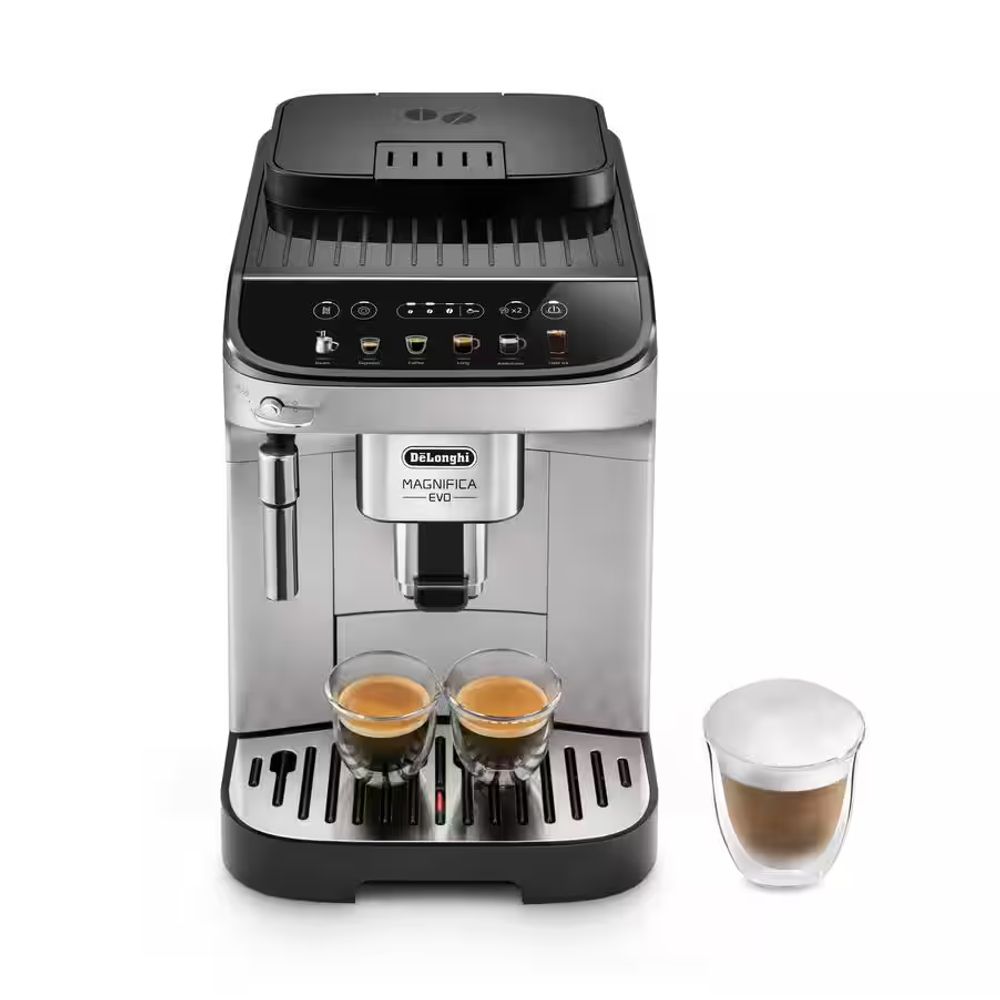
Magnifica Evo Espresso Machine (ECAM29043SB)
$749.95. A bean-to-cup super-automatic with a 13-setting conical burr grinder and a manual steam wand for milk.
Shop NowThe Magnifica Evo's argument is time. Beans in the hopper, water in the tank, and every drink from espresso to americano is one button away. De'Longhi puts a conical burr grinder inside with 13 settings, describing them as ensuring "the coffee beans of your choice are ground as evenly and finely as possible." The machine handles dosing, tamping and puck ejection into an internal bin, so the only cleanup is emptying it.
De'Longhi markets it as the "#1 Super Automatic Espresso Maker in the US," a claim it footnotes to Circana Retail Tracking Service unit share data for January to December 2025. That's a sales-volume position rather than a quality verdict, and it's worth reading as such.
Milk is where expectations need managing. This model has what De'Longhi calls a "traditional milk frother," meaning a manual steam wand you operate yourself. Automating the coffee doesn't automate the cappuccino. If you want the machine to handle milk too, that's the Magnifica Evo with LatteCrema System at $899.95, $150 above this one.
The ceiling is the honest limitation. A super-automatic decides the extraction variables for you, which is the entire point and also the constraint. You can change the grind and the volume, but you can't chase a specific shot the way a portafilter lets you. For most people that's a fair trade. For anyone who gets interested in coffee later, it's the reason they end up buying a second machine.
At 14.2 inches tall, 17.3 inches deep and 9.5 inches wide, it also needs genuine counter depth, and the bean hopper sits on top so it wants clearance above.
Best for: Households where several people want different drinks quickly, anyone who values consistency over control, and buyers who don't want espresso to become a project.
Shop the De'Longhi Magnifica Evo now.
Breville Barista Express: The One That Teaches You
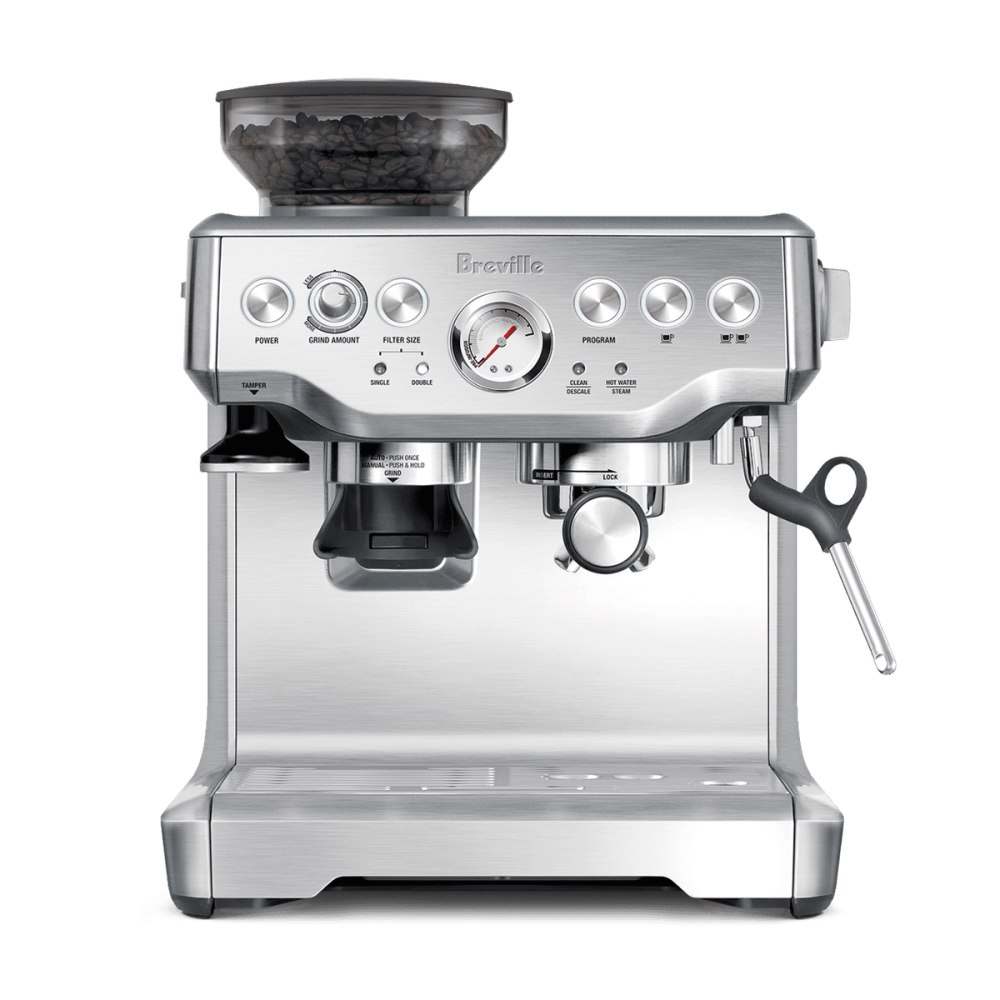
the Barista Express (BES870XL)
$699.95. A semi-automatic with a 16-setting burr grinder, 54mm portafilter and PID temperature control at 200°F.
Shop NowThe Barista Express has been the default first espresso machine for over a decade, and the spec explains why. Breville pairs an integrated conical burr grinder with 16 settings to a 54mm stainless steel portafilter, targeting an 18g dose. Extraction runs "low pressure pre-infusion followed by 9 bar extraction" through a "15 bar Italian pump."
The detail that matters most is temperature. Breville uses a "Thermocoil heating system with PID temperature control" that it says "delivers water at exactly 200°F." Espresso is unforgiving about brew temperature, and PID control at this price is the single strongest technical argument the Barista Express makes against the Magnifica Evo, whose temperature handling De'Longhi doesn't publish.
Milk works the same way as its rival. Breville describes "manual hand-crafted microfoam" from a steam wand "designed to quickly turn milk into smooth microfoam with a delicious silky texture, ready for pouring latte art." Neither machine froths for you.
The cost is effort and mess. You tamp every shot, you knock the puck out yourself, and you'll spend the first couple of weeks dialling in grind size before the shots stop running fast or choking. Breville sells accessories that suggest as much: a Distribution Duo 54mm at $109.95 and a Knock Box 10 at $33.95 are both listed as usual companion purchases.
What you get for that effort is headroom. Better beans, a finer grind adjustment and a better tamp all show up in the cup, which isn't true of a super-automatic in the same way. Breville's smaller Bambino is the cheaper way into the same semi-automatic workflow if counter space is tight.
Best for: One or two drinkers who find the process satisfying, anyone who wants to learn espresso properly, and buyers who care about brew temperature stability.
Shop the Breville Barista Express now.
Which Makes Better Espresso?
The Barista Express has the higher ceiling and the Magnifica Evo has the higher floor.
Breville's PID temperature control, pre-infusion and manual dose control give a skilled user more levers than any super-automatic at this price. Dialled in well, a Barista Express shot beats a Magnifica Evo shot. Dialled in badly, it's considerably worse, and dialling in takes practice and wasted coffee.
The Magnifica Evo removes that variance. Its shots land in a narrow band every time, which is why it suits a household rather than an enthusiast. It works on a Tuesday morning without anyone having learned a thing.
Neither machine wins on milk, because both use a manual wand. Whichever you choose, latte art is a skill you'll be learning yourself.
Does the $50 Price Gap Matter?
No, and treating this as a price comparison is the mistake most buyers make.
The Magnifica Evo is $749.95 and the Barista Express is $699.95, a 7% difference on machines that work in fundamentally different ways. Choosing on $50 is choosing on noise.
The prices that matter are the ones on either side. De'Longhi's Magnifica Start is $649.95 if you want super-automatic for less, the Magnifica Evo with LatteCrema is $899.95 if you want milk automated, and the Magnifica Evo Next is $1,099.95. On the Breville side, budget for a knock box and possibly a better tamper, which adds $30 to $110 to the real cost.
Which Should You Buy?
Buy the Magnifica Evo if more than one person makes coffee, mornings are rushed, or the idea of tamping and dialling in sounds like a chore rather than a pleasure. It's the machine that keeps working when no one wants to think.
Buy the Barista Express if you want to make espresso rather than obtain it. The PID temperature control and 54mm portafilter give you real control, and the machine rewards attention in a way the De'Longhi structurally can't.
Buy the Magnifica Evo with LatteCrema at $899.95 instead of either if your household mostly drinks milk-based coffee and no one wants to steam it. That's the gap neither of these two machines fills.
Five Things to Know Before You Choose
Neither machine froths milk for you
Both the Magnifica Evo and the Barista Express use a manual steam wand. Automating the espresso doesn't automate the cappuccino. De'Longhi's auto-frothing LatteCrema version is $899.95.
PID temperature control is Breville's strongest card
The Barista Express uses a Thermocoil system with PID control that Breville says holds water at exactly 200°F. De'Longhi doesn't publish temperature control figures for the Magnifica Evo.
Budget past the sticker price on the Breville
Breville lists the Distribution Duo 54mm at $109.95 and the Knock Box 10 at $33.95 as usual companion purchases. A semi-automatic realistically costs more than its box price.
The $50 gap is not the decision
At $749.95 against $699.95 these machines are 7% apart, which is noise next to the difference between pressing a button and pulling a shot. Choose the workflow, not the price.
Measure your counter before ordering the De'Longhi
The Magnifica Evo is 14.2 inches tall, 17.3 inches deep and 9.5 inches wide, with a top-loading bean hopper. It needs both counter depth and clearance above to refill.
Frequently Asked Questions
Is the De'Longhi Magnifica Evo better than the Breville Barista Express?
Neither is better outright, because they're different machine types. The Magnifica Evo ($749.95) is a super-automatic that grinds, tamps and brews at a button press. The Barista Express ($699.95) is a semi-automatic with a 54mm portafilter you fill and tamp yourself. The De'Longhi is more consistent with no skill. The Breville reaches higher with practice.
What is the difference between a super-automatic and a semi-automatic espresso machine?
A super-automatic grinds, doses, tamps, brews and ejects the puck in one automated cycle, so there's no portafilter. A semi-automatic controls pressure and temperature but leaves preparation to you: you dose into a portafilter, tamp it, and lock it in. The Magnifica Evo is the first kind, the Barista Express the second.
Do the Magnifica Evo and Barista Express froth milk automatically?
No. Both use a manual steam wand you operate yourself. De'Longhi calls its version a "traditional milk frother" and Breville describes "manual hand-crafted microfoam." If you want milk automated, De'Longhi's Magnifica Evo with LatteCrema System is $899.95, which is $150 above the standard Magnifica Evo.
Which has the better grinder?
Both use integrated conical burr grinders, and the difference is in adjustment range rather than type. The Barista Express offers 16 grind settings and doses on demand into the portafilter. The Magnifica Evo offers 13. More settings matter more on the semi-automatic, because grind size is the main lever you use to dial in a shot.
How much do the Magnifica Evo and Barista Express cost?
The De'Longhi Magnifica Evo (ECAM29043SB) is $749.95 on De'Longhi's US site and the Breville Barista Express (BES870XL) is $699.95 on Breville's, a difference of $50. De'Longhi's range runs from the Magnifica Start at $649.95 to the Magnifica Evo Next at $1,099.95, with the LatteCrema version at $899.95 in between.
Is the Barista Express hard to use?
It has a real learning curve, mostly around grind size. Expect a couple of weeks of shots running too fast or choking before you find the setting your beans want, and expect to waste some coffee getting there. Once dialled in, the routine takes under a minute. If that sounds tedious rather than enjoyable, the Magnifica Evo is the better buy.
