

One of these pans you can scrape with a metal spatula and put in the dishwasher. The other will lose its coating if you do either. That single difference explains most of what separates HexClad from Caraway, and it matters more than the price gap.
A HexClad 10-inch Hybrid Fry Pan is $149. A Caraway 10.5-inch ceramic fry pan is $125. Close enough that price won't decide it. What decides it is whether you want a pan that survives rough handling or a pan that looks beautiful on an open shelf and asks to be handled gently.
Ceramic Nonstick vs Hybrid: What's the Actual Difference?
Ceramic nonstick is a sol-gel coating over an aluminum body, covering the entire cooking surface. Nothing interrupts it, so release is excellent and searing is mediocre, and anything that scratches the coating damages the pan.
Hybrid cookware raises a stainless steel pattern above the coating. The steel takes the contact from utensils and delivers browning, while nonstick sits in the recesses. Release is worse than a pure ceramic pan. Durability is better.
Caraway is the first kind. HexClad is the second. Both now use coatings made without PTFE, PFOA, and PFAS, so the old chemistry argument between them has largely gone away. What's left is a genuine design disagreement about whether a nonstick surface should be protected or exposed.
HexClad vs Caraway at a Glance
| Feature | HexClad | Caraway |
|---|---|---|
| 10" fry pan | $149 ($169 with lid) | $125 (10.5") |
| Full set | $699 (12-pc pots and pans) | $445 (12-pc, list $675) |
| Surface | Laser-etched stainless hexagons over TerraBond ceramic | Ceramic coating across the whole surface |
| Body | Tri-ply, aluminum core | Aluminum with stainless handles and base plate |
| Metal utensils | Yes | No |
| Dishwasher | Yes | No, the brand says it damages the coating |
| Oven safe | 900°F, glass lids 400°F | 550°F |
| Induction | Yes | Yes |
| Colorways | Dark, uniform finish | 8 (Cream, Navy, Gray, Sage, Perracotta, Marigold, Black, White) |
| Storage included | No | Magnetic pan racks and canvas lid holder |
| Warranty | Lifetime against manufacturer defects | Brand warranty, coating wear excluded |
| Reviews on the flagship pan | 3,085 | 18,167, averaging 4.8 out of 5 |
Bottom line: Buy HexClad if you cook hot, use metal tools, and want the pan in the dishwasher. Buy Caraway if you want the best release, the storage system, a specific colour in your kitchen, and you're willing to hand wash.
HexClad: Built to Take Abuse
HexClad launched in 2017, founded by Daniel Winer and Cole Mecray, and made Gordon Ramsay its lead ambassador in July 2021. Its whole proposition is that the coating shouldn't be the part you baby.
The construction is tri-ply with an aluminum core, topped by laser-etched stainless hexagonal peaks with TerraBond ceramic nonstick in the valleys between them. Because the steel stands proud of the coating, HexClad states the pans are metal utensil safe and dishwasher safe, and oven safe to 900°F. The tempered glass lids are rated to 400°F, so those come off before the broiler goes on.
To give you a sense of pricing, the 10" Hybrid Fry Pan is $149 on its own and $169 with a lid, the 12" with lid is $199, and the 12-piece Hybrid Pots & Pans Set is $699. The 10-inch pan carries 3,085 reviews on HexClad's own site.
What HexClad gives up is release. A hexagon grid means the cooking surface is part steel, and steel sticks. Eggs and fish need more fat in a HexClad pan than in a Caraway one, and the brand's own guidance is to preheat properly and let food release rather than forcing it. If your main reason for owning nonstick is an effortless omelette, that's a real cost.
The other gap is looks. HexClad comes in one dark, industrial finish. It's a good-looking pan, but it isn't a decorating decision.
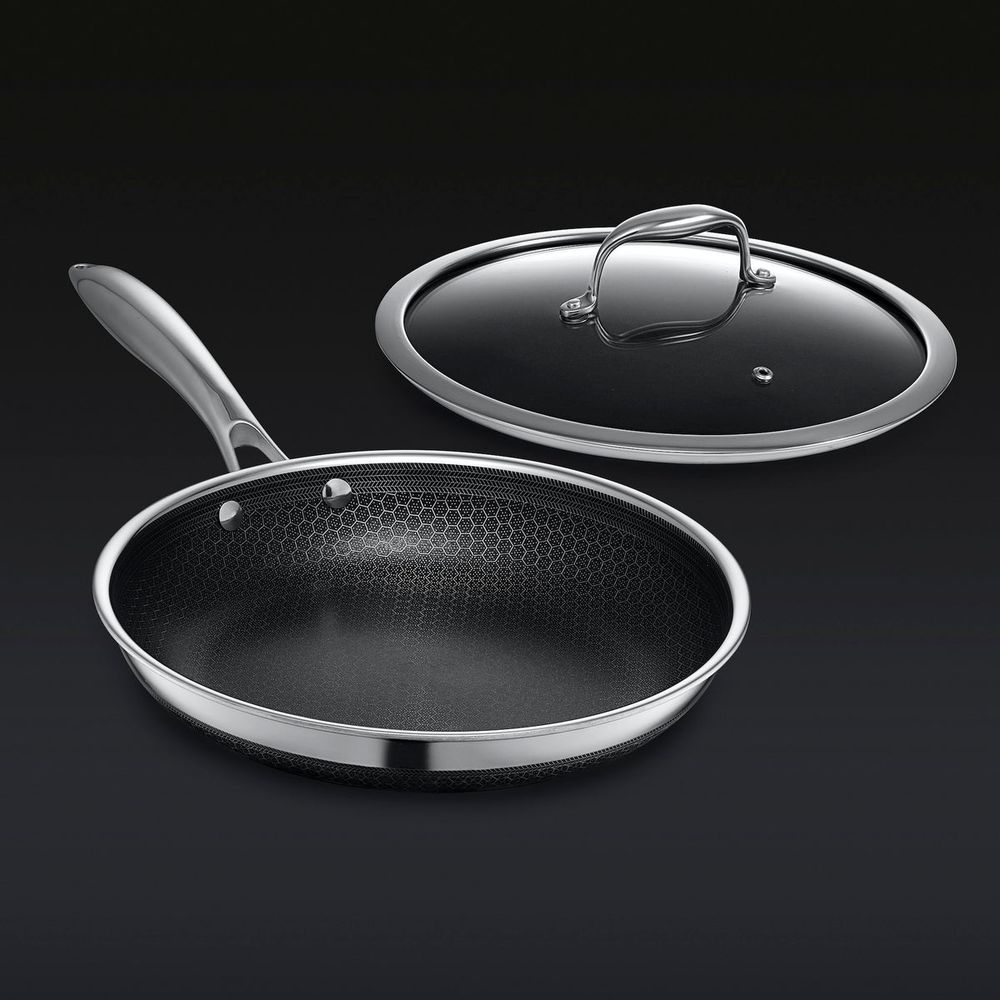
Hybrid Fry Pan, 10"
Stainless hexagons over PTFE-free ceramic. Metal utensil safe, dishwasher safe, oven safe to 900°F.
Shop NowBest for: Cooks who sear, use metal tools, run a hot oven, and want to stop thinking about how they treat a pan.
Caraway: Built to Be Looked At
Caraway launched in 2019 after founder Jordan Nathan overheated a PTFE-coated pan in his apartment in 2017 and ended up calling poison control. The company opened with a waitlist of more than 150,000 people, and it more or less created the modern non-toxic cookware category.
The build is an aluminum body with a ceramic-coated interior and stainless steel handles and a stainless base plate, made without PTFE, PFOA, PFAS, lead, and cadmium. It's oven safe to 550°F and works on gas, electric, and induction.
The 12-piece Cookware Set is $445, down from a $675 list, and includes a 10.5" fry pan, an 8" mini fry pan, a 3-quart sauce pan, a 1.75-quart mini sauce pan, a 4.5-quart sauté pan, and a 6.5-quart Dutch oven, with lids. Storage organizers are a $50 add-on. Individually, the 10.5" fry pan is $125 and it's rated 4.8 out of 5 across 18,167 reviews, which is the deepest single-product review base in this comparison.
Where Caraway wins outright is release and appearance. An unbroken ceramic surface releases better than a hexagon grid, full stop. And eight colorways, from Cream to Perracotta to Marigold, make it the only one of the two you'd choose to leave on the stovetop.
Where it loses is handling. Caraway states plainly that you should not put its pans in the dishwasher, because it damages the ceramic coating, and metal utensils are out. That's not a quirk, it's the trade for an uninterrupted coating. Combined with a 550°F ceiling against HexClad's 900°F, Caraway asks for a gentler kitchen.
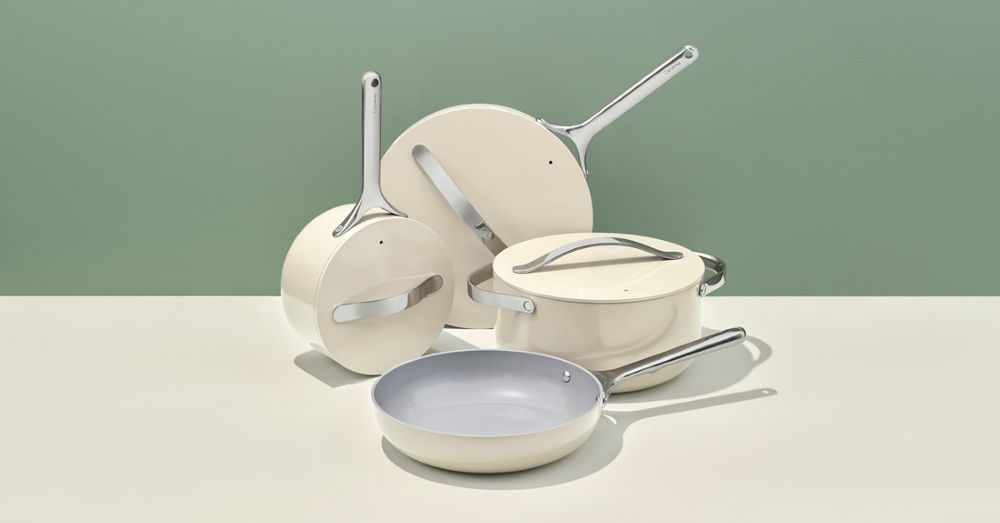
Ceramic Cookware Set, 12-Piece
Ceramic-coated aluminum in eight colorways, with magnetic pan racks. Hand wash only, oven safe to 550°F.
Shop NowBest for: Cooks who want the easiest release, care how the kitchen looks, need cabinet space back, and don't mind hand washing.
Which Costs More Over Time?
On the sticker, Caraway is cheaper for a full kitchen: $445 for the 12-piece set against $699 for HexClad's. On a single pan they're close, $125 against $149.
The more useful question is replacement rate, and here the honest answer is that nobody can promise you a number. Ceramic coatings lose release faster than the PTFE they replaced, and that applies to both brands, since HexClad's TerraBond is also ceramic. The difference is what happens around the coating. HexClad's steel hexagons shield the ceramic from utensils and scrubbing, and the pan tolerates the dishwasher. Caraway's coating is fully exposed and the brand rules the dishwasher out.
Which is to say the durability argument runs in HexClad's favour, but it's a design argument, not a measured one, and we haven't run a multi-year test to put numbers on it. Treat any specific lifespan claim you read about either brand with suspicion.
Both discount heavily, which changes the math more than most people expect. HexClad advertises up to 30 percent off sitewide. Caraway's 12-piece set sits at $445 against a $675 list, a 34 percent cut, and goes further around Memorial Day, July 4th, and Black Friday. Neither list price is real. If you want the wider ceramic field on price, we compared three of the biggest names in Caraway vs GreenPan vs HexClad.
Which One Should You Choose?
Buy Caraway if: Eggs, fish, and pancakes are the reason you want nonstick. The pans live on open shelving or a visible stovetop. Cabinet space is tight and the magnetic racks solve it. Colour matters. You already hand wash.
Buy HexClad if: You sear more than you fry. Metal tongs and spatulas are what you actually reach for. You want the pans in the dishwasher. You finish dishes under a broiler or in a very hot oven. You'd rather not think about how a pan gets treated.
Buy neither if: You want one pan to do everything for under $80, in which case a cast iron skillet plus a cheap ceramic pan covers both jobs for less than either brand's single fry pan. Or you cook at high heat constantly, where bare stainless or carbon steel outlasts any coated pan by decades. The full clad comparison is in All-Clad D3 vs HexClad.
5 More Things to Know Before You Buy
- Caraway's no-dishwasher rule is not a suggestion. The brand states directly that a dishwasher will damage the ceramic coating. If your household reliably loads everything into the dishwasher regardless of instructions, that decides this comparison on its own.
- HexClad's oven rating doesn't extend to its lids. The pans go to 900°F. The tempered glass lids stop at 400°F. Take the lid off before broiling.
- Skip cooking spray on both. Aerosol propellants polymerise into a residue that builds up on ceramic and causes the sticking people then blame on the coating. Oil or butter from a bottle avoids it entirely.
- Neither warranty covers the coating wearing out. HexClad's lifetime warranty covers manufacturer's defects and explicitly excludes excessive heat, misuse, and improper cleaning, and states that cosmetic change over time is normal wear. Caraway's coverage works the same way. Plan on replacing any ceramic pan eventually.
- Caraway's set count includes the storage. Its "12-piece" set counts lids and, in some configurations, the racks. Six cooking vessels is the real number. Compare cooking vessels, not piece counts, whichever brands you're weighing up.
Frequently Asked Questions
Is HexClad better than Caraway?
Neither is better across the board, because they solve different problems. HexClad is metal utensil safe, dishwasher safe, and oven safe to 900°F, which makes it the more durable and more forgiving pan. Caraway has an uninterrupted ceramic surface, so it releases food better, and it comes in eight colorways with a magnetic storage system. HexClad's 10-inch fry pan is $149 against $125 for Caraway's 10.5-inch. Choose on handling and release rather than on price.
Can you use metal utensils on Caraway?
No. Caraway's ceramic coating covers the full cooking surface with nothing raised above it, so metal utensils scratch it and the scratches spread. Use silicone, wood, or nylon. HexClad allows metal utensils because its stainless steel hexagons stand above the coating and take the contact, which is the central design difference between the two brands.
Is Caraway dishwasher safe?
No. Caraway states on its own product pages not to put its pans in the dishwasher, because it damages the ceramic coating. HexClad lists its Hybrid pans as dishwasher safe. For a lot of households this single line decides the purchase, so it's worth settling before comparing anything else.
Which lasts longer, HexClad or Caraway?
The design argument favours HexClad: its steel hexagons shield the ceramic from utensils and scrubbing, and the pan tolerates a dishwasher, while Caraway's coating is fully exposed and hand wash only. But both use ceramic nonstick, which loses release properties faster than PTFE did, and neither brand's warranty covers that wear. Be sceptical of any source quoting a precise lifespan for either.
Is Caraway or HexClad better for eggs?
Caraway. An unbroken ceramic surface releases better than a surface interrupted by stainless steel ridges, and eggs are the clearest case where that matters. HexClad pans handle eggs with enough fat and a proper preheat, but they will never match a full-coverage nonstick at it. If eggs and fish are the main reason you want the pan, that points at Caraway.
Why is the Caraway set cheaper than HexClad's?
Caraway's 12-piece set is $445 against $699 for HexClad's 12-piece Hybrid Pots & Pans Set, and the gap comes from construction as much as positioning. Caraway pans are an aluminum body with a ceramic coating and a stainless base plate, while HexClad is tri-ply with an aluminum core bonded between stainless and a laser-etched steel surface. Both brands discount heavily, so check the current price on each before treating the gap as fixed.
