


An 8-inch HexClad Hybrid Fry Pan costs $129. An 8-inch David Burke GeoClad costs $29.99. Both are tri-ply pans with a laser-etched pattern of raised stainless steel peaks sitting over nonstick ceramic valleys.
The design isn't a coincidence and it isn't quite a copy. Hybrid cookware is a category now, and GeoClad is the cheapest credible version of it from a name you'd recognise. Buy three GeoClad pans and you've spent $115.07. The same three HexClad pans are $457.
What that $341.93 doesn't buy you is the part most comparisons skip.
What Is Hybrid Cookware, and Why Do Both Brands Use It?
Hybrid cookware is cookware with a raised stainless steel pattern laser-etched above a nonstick surface. The steel peaks take the contact from spatulas, tongs and scrubbing, while the nonstick valleys between them handle food release. The point is to get the searing behaviour of stainless and the release of nonstick without the coating wearing through in a year. It's the same reasoning behind Circulon's raised circles, which we compare in our Circulon vs HexClad breakdown.
Both brands build it the same way underneath. HexClad describes "tri-ply construction" featuring "an aluminum core for fast and even heating," with "hexagonal steel ridges for incredible searing power and durability." David Burke Cookware describes GeoClad as a "laser-etched geometric pattern over ceramic coating" on a body of "3-ply construction with an aluminum core layer sandwiched between stainless steel."
That's the same sandwich and the same surface concept. The difference is the pattern geometry, the coating formulation, and everything that happens around the pan rather than in it.
David Burke Geo Clad vs HexClad at a Glance
| Feature | David Burke GeoClad | HexClad |
|---|---|---|
| Surface | Laser-etched steel peaks over ceramic valleys | Hexagonal steel peaks over TerraBond ceramic valleys |
| Body | Tri-ply, aluminum core | Tri-ply, aluminum core |
| Coating claim | "100% PTFE and PFOA-free" | TerraBond ceramic, PFAS-free |
| Independent testing | None published | Third-party lab, results below detection limit |
| Oven safe to | 500°F | 900°F |
| Induction | Yes | Yes |
| Metal utensils | Yes | Yes |
| 8-inch pan | $29.99 | $129 |
| 10-inch pan | $34.99 | $149 |
| 12-inch pan | $50.09 | $179 |
| Sold direct by the brand | No, Amazon only | Yes |
| Warranty | Limited lifetime | Lifetime against defects, registration required |
Bottom line: Buy GeoClad if you want to try hybrid cookware without committing $457 to find out whether you like it. Buy HexClad if you need the 900°F ceiling, want independently tested coating claims, or want to buy from a brand that runs its own store.
David Burke Geo Clad: The Same Idea for a Quarter of the Price
GeoClad is the value proposition in this comparison, and the pricing is striking. The 8-inch pan is $29.99, the 10-inch is $34.99, and the 12-inch is $50.09. Against HexClad that's 23% of the price at the two smaller sizes and 28% at the 12-inch.
The pan itself is not a cheap knock-off in construction terms. It's tri-ply with an aluminum core, it works on gas, electric coil and induction, and the brand describes the coating as "100% PTFE and PFOA-free." David Burke is a working chef and restaurateur rather than a licensing shell, and the cookware line spans Black Cube, GeoClad, Splendor Stainless and Stature collections.
Then there's the distribution, which is where buyers should slow down. David Burke Cookware publishes no prices on its own website and sells exclusively through Amazon, disclosing on its own site that it participates in the Amazon Associates affiliate programme. There is no direct storefront, no brand checkout, and no published set pricing.
That has practical consequences. Amazon listings for the line are unstable: the long-running 12-piece set listing now resolves to a 1.5-quart saucepan, and one GeoClad listing returned "This item cannot be shipped to your selected delivery location." Review depth is thin too. The 12-inch GeoClad pan carried 4.5 stars across 75 reviews, which is a reasonable score on a small sample rather than a proven track record.
Best for: Cooks who want to find out whether the hybrid surface suits them before spending HexClad money, and who are comfortable buying through Amazon with no brand storefront behind it.
HexClad: What the Extra $100 a Pan Buys
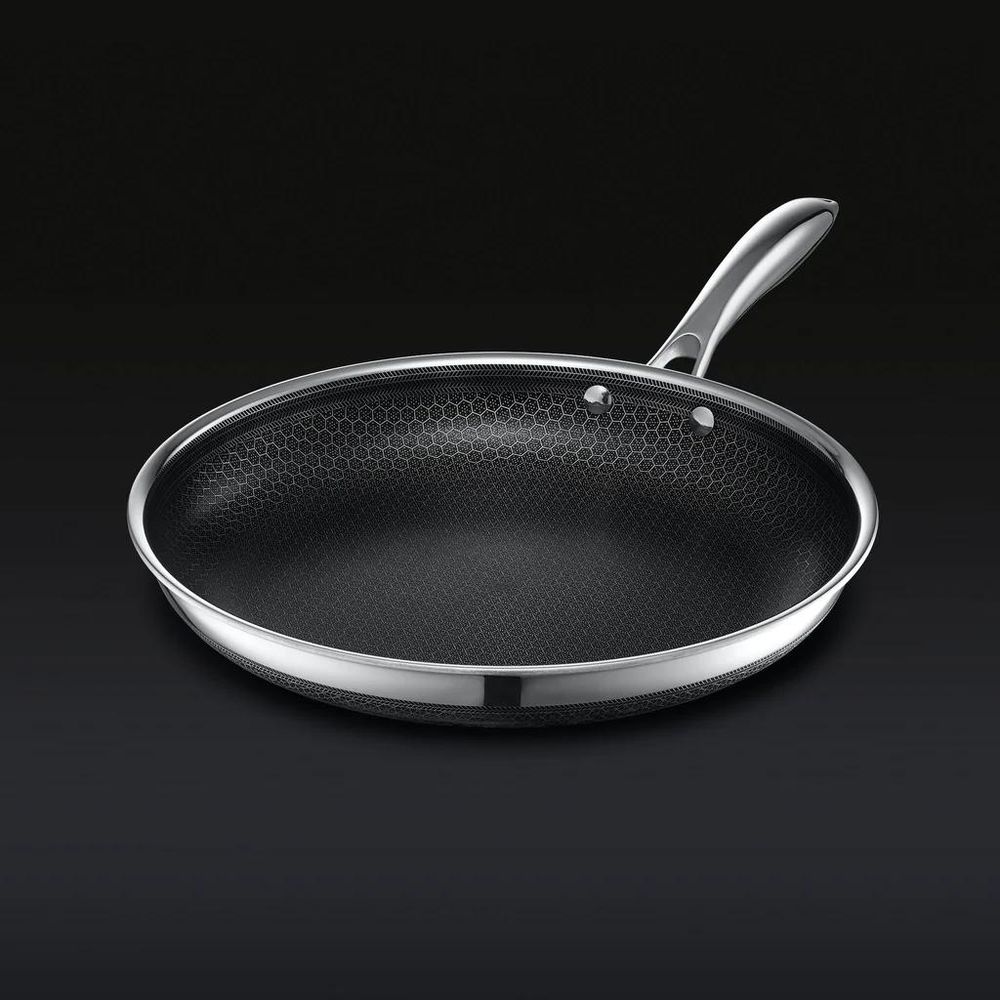
Hybrid Fry Pan, 12-Inch
$179. Tri-ply with laser-etched steel hexagons over TerraBond ceramic, oven safe to 900°F and metal-utensil safe.
Shop NowThe headline difference is heat. HexClad states its pans are "metal utensil–safe, dishwasher-safe and oven-safe up to 900°F." GeoClad's 12-inch listing specifies "Oven safe to 500°F." Both numbers comfortably clear everyday roasting, but 900°F means broiler work and hard sears carry no thermal risk at all, while 500°F sets a real ceiling.
The second difference is evidence. Both brands claim a clean coating, and only one shows its work. HexClad's TerraBond ceramic is described as "free from PTFE and forever chemicals," and the brand reports a third-party lab "tested our pots and pans for PFAS compounds and all results were below the laboratory's detection limit." GeoClad's "100% PTFE and PFOA-free" is a brand claim with no published testing behind it. Notably, PFOA-free is a weaker statement than PFAS-free, because PFOA is one compound within the broader PFAS family.
The third is the ecosystem. HexClad sells direct, publishes prices, runs a warranty portal, and has the scale that comes with Gordon Ramsay as an equity partner since 2021 and a $100 million investment from Studio Ramsay Global in July 2024. Its warranty is lifetime against manufacturer's defects, though it requires registration, doesn't transfer, and excludes normal wear.
The trade-off is the money. A 12-inch pan is $179 and the 6-piece fry pan set is $399, which is more than three GeoClad pans and a spare.
Best for: Cooks who roast hot or broil, who want coating claims backed by testing rather than assertion, and who want a brand they can buy from and claim against directly.
Where the Two Actually Differ
On the stovetop, the two pans are built on the same principle and the same tri-ply structure, so the everyday searing-and-release behaviour should be broadly comparable. Four things separate them, and none is about how the pan cooks an egg.
The oven ceiling is 500°F against 900°F. The coating evidence is a brand claim against a third-party lab result. The warranty route is an Amazon return or a manufacturer claim against a registered lifetime warranty with a portal behind it. And the review history is 75 reviews on the 12-inch GeoClad against HexClad's mass-market volume built since 2016.
None of those makes GeoClad a bad pan. They make it a less proven one, bought through a channel the brand doesn't control, and that's a reasonable thing to accept for a $99 saving on a single pan.
What Else David Burke Sells, and Why It Matters Here
GeoClad is one line out of six, and that changes the comparison if you're weighing the brands rather than these two pans. HexClad makes hybrid cookware and nothing else, so every pan it sells is a version of the same hexagon. David Burke runs GeoClad alongside four conventional stainless steel lines and a bakeware range, all in the same $35 to $60 band.
The stainless lines have no HexClad equivalent at all. The Regency 10" fry pan is $34.99, described on its listing as commercial-grade heavy-gauge stainless with a thicker base for even heating, riveted handles and pouring spouts, rated 4.2 out of 5 across 22 ratings and oven safe to 400°F. A Splendor 12.5" fry pan is $59.99, a Splendor 3-quart Dutch oven with glass lid is $34.99, and a Prestige 5.3-quart Dutch oven with strain lid is $49.99. Stature and Gourmet Pro fill in further pieces.
Two things follow. First, if you want a hybrid pan and a plain stainless pan, David Burke sells both in one aesthetic for less than a single HexClad pan, which is a genuinely different proposition from choosing between coated and uncoated. Second, the oven ratings vary by line rather than by brand: GeoClad is 500°F, but the Regency stainless is only 400°F, which is low even for uncoated steel. Check the rating on the specific line rather than assuming the brand.
One clarification worth making, because the brand's own site invites the confusion. David Burke's website describes a "Black Cube" hybrid collection, but Black Cube on Amazon is a Frieling product. Neither company's own pages explain the relationship, so treat any Black Cube listing as a separate purchase decision from the David Burke lines above.
Does the Saving Hold Up?
Yes, and it's large enough to change how you shop.
| Setup | David Burke GeoClad | HexClad | You keep |
|---|---|---|---|
| 8-inch pan | $29.99 | $129 | $99.01 |
| 10-inch pan | $34.99 | $149 | $114.01 |
| 12-inch pan | $50.09 | $179 | $128.91 |
| All three | $115.07 | $457 | $341.93 |
Three GeoClad pans cost 25% of three HexClad pans. Put another way, a full GeoClad trio is cheaper than a single 8-inch HexClad, with $14 left over.
The honest framing is that GeoClad lets you test the hybrid concept for the price of one mid-range nonstick pan. If the surface suits how you cook, you've saved a lot. If it doesn't, you've lost $30 rather than $129.
Which Should You Buy?
Buy David Burke GeoClad if you're curious about hybrid cookware and unwilling to pay to find out. Start with the 8-inch at $29.99. Cook on it for a month. It handles induction, metal utensils and a 500°F oven, which covers most of what a home kitchen asks of a pan.
Buy HexClad if you already know you want hybrid and you want the version with the higher ceiling, the tested coating and a company you can contact. The 12-inch at $179 is the size that does most of the work.
Buy neither if you mainly want nonstick for eggs at low heat. Hybrid pans ask for a preheat, and a conventional coated pan does that job for less than either of these. Our Caraway vs GreenPan vs HexClad comparison covers the ceramic options worth looking at instead.
Five Things to Know Before You Choose
PFOA-free and PFAS-free are not the same claim
GeoClad is marketed as "100% PTFE and PFOA-free." HexClad's TerraBond is described as PFAS-free with third-party lab testing. PFOA is a single compound inside the wider PFAS family, so the two statements cover different ground.
The oven ceiling is 400 degrees apart
GeoClad's 12-inch pan is rated to 500°F. HexClad is rated to 900°F. Both clear normal roasting, but only one is unbothered by a broiler.
David Burke has no store of its own
The brand's site publishes no prices and routes every product to Amazon, disclosing its own affiliate participation. There is no direct checkout and no brand-run warranty portal.
Check the ASIN before you buy GeoClad
Amazon listings for the line move around. The long-standing 12-piece set listing now resolves to a 1.5-quart saucepan, and at least one listing reported a delivery restriction. Confirm the size and piece count on the page you're buying from.
Both need a preheat
Raised steel peaks behave like stainless steel. Bring either pan up on medium and add fat before food goes in, or the food will catch on the ridges regardless of which brand you bought.
Frequently Asked Questions
Is David Burke GeoClad a good HexClad alternative?
GeoClad is a credible alternative on design and a clear win on price. It uses the same laser-etched steel-peaks-over-ceramic-valleys surface on the same tri-ply aluminum-cored body, at 23% to 28% of HexClad's price. What you give up is the 900°F oven rating, published third-party coating tests, a direct storefront, and a deep review history.
How much cheaper is GeoClad than HexClad?
GeoClad costs roughly a quarter of HexClad. The 8-inch pans are $29.99 against $129, the 10-inch are $34.99 against $149, and the 12-inch are $50.09 against $179. Buying all three sizes costs $115.07 from David Burke and $457 from HexClad, a saving of $341.93. A full GeoClad trio is cheaper than one 8-inch HexClad.
Can you use metal utensils on GeoClad and HexClad?
Yes on both, and it's the main reason to buy either. The raised stainless steel pattern sits above the nonstick surface, so a metal spatula rides on the steel rather than scraping the coating. HexClad states its pans are "metal utensil–safe" and dishwasher safe. GeoClad's stainless sear surface is designed the same way.
What temperature can GeoClad and HexClad go in the oven?
The 12-inch GeoClad is rated oven safe to 500°F. HexClad is rated to 900°F. Both handle standard roasting temperatures without trouble. The gap matters for broiler finishing and very high-heat roasting, where HexClad has 400°F of headroom that GeoClad does not.
Where can you buy David Burke GeoClad?
Through Amazon. David Burke Cookware's own website publishes no prices and links every product to Amazon, disclosing that it participates in the Amazon Associates programme. The line also appears on eBay and independent retailers, and on resale sites like Poshmark. Because listings shift, confirm the piece count and size on the specific listing before ordering.
Is David Burke cookware as good as HexClad overall?
On the hybrid pans, the construction is closely matched: both are tri-ply with an aluminum core and raised stainless steel over a ceramic coating, at roughly a quarter of the price from David Burke. Across the brands, HexClad's advantages are the 900°F oven rating, published third-party coating testing, a direct storefront and warranty, and a far deeper review history. David Burke's advantage is breadth for the money, with GeoClad plus four stainless lines all between $35 and $60.
What is the difference between David Burke GeoClad and Splendor?
GeoClad is the ceramic hybrid line, with laser-etched stainless steel peaks over nonstick ceramic valleys on a tri-ply body, oven safe to 500°F. Splendor is conventional stainless steel with a tri-ply aluminum core and no coating at all, with a 12.5-inch fry pan at $59.99 and a 3-quart Dutch oven with glass lid at $34.99. Regency, Prestige and Stature are further stainless lines from the same brand, priced similarly.
Are GeoClad and HexClad PFAS-free?
HexClad states its TerraBond ceramic coating is "free from PTFE and forever chemicals" and reports third-party lab results below the detection limit for PFAS compounds. David Burke markets GeoClad as "100% PTFE and PFOA-free," which is a narrower claim, since PFOA is one compound within the PFAS family, and the brand publishes no independent testing.
