


A 12-inch Circulon ScratchDefense frying pan costs $69.99. The 12-inch HexClad Hybrid Fry Pan costs $179. The cheaper pan taps out at 400°F in the oven. The expensive one is rated to 900°F.
That gap is the whole comparison in miniature. One brand has spent forty years making nonstick last longer for less money. The other builds a pan you can sear a steak in, slide into a screaming oven, and scrub with a metal spatula. Both are good at what they do, and neither is trying to do the other's job.
What's Actually Different About Circulon and HexClad?
Hybrid cookware is cookware with a raised stainless steel pattern sitting above a nonstick surface, so utensils ride on the steel instead of scraping the coating. HexClad built its entire business on that idea, and the hexagon is where the name comes from.
Circulon got to the same problem thirty years earlier and solved it differently. Its TOTAL Nonstick System uses raised circles rather than steel peaks, and the whole surface, circles included, is coated. Circulon describes it as "raised circles with three layers of nonstick for outstanding food release that lasts." The circles reduce how much of the coating a spatula touches, which is the same logic as the hexagons at a lower price and a lower heat ceiling.
The construction underneath differs too. Circulon's signature ranges are hard-anodized aluminum, which the brand says is "twice as hard as stainless steel." HexClad is tri-ply, with an aluminum core sandwiched between stainless layers. That's why one is oven safe to 400°F and the other to 900°F.
Circulon vs HexClad at a Glance
| Feature | Circulon | HexClad |
|---|---|---|
| Founded | 1985, by Meyer Corporation | December 2016, Los Angeles |
| Cooking surface | Raised circles, triple-layer nonstick | Hexagonal stainless peaks, ceramic valleys |
| Body construction | Hard-anodized aluminum (clad on C1 Series) | Tri-ply stainless with aluminum core |
| Coating | Fluoropolymer (PTFE, FEP, PFA) on most lines | TerraBond ceramic |
| PFAS | Intentionally added, per Circulon's own disclosure | Brand states PFAS-free, third-party tested |
| Oven safe to | 400°F on hard-anodized lines, 500°F on C1 Clad and Halo Ceramic | 900°F |
| Metal utensils | Yes on ScratchDefense lines | Yes |
| Dishwasher | Yes | Yes |
| Induction | Yes | Yes |
| 12-inch fry pan | $69.99 | $179 |
| Multi-piece set | $329.99 for 10 pieces | $699 for 12 pieces |
| Warranty | Limited lifetime, plus a money-back guarantee on ScratchDefense | Lifetime against defects, registration required |
Bottom line: Buy Circulon if most of what you cook is eggs, pancakes, fish and weeknight dinners at moderate heat, because you get a complete set for the price of two HexClad pans. Buy HexClad if you sear, finish things in a hot oven, or want a PFAS-free coating without giving up metal utensils.
Circulon: More Nonstick Per Dollar
Circulon invented this category. Meyer Corporation launched the brand in 1985 as the first cookware to marry hard-anodized aluminum with a durable nonstick system, and the patented Hi-Low circle pattern has been its signature ever since. Forty years of iteration is why a 10-piece ScratchDefense set lands at $329.99 while a 10-piece Premier Professional set is $299.99.
The claims Circulon makes for ScratchDefense are unusually specific. The brand says the surface "lasts 130X longer than the competition and stands up to laboratory tests simulating 200+ years of daily wear and tear." Its older hard-anodized lines are marketed as lasting "10x longer than ordinary" nonstick. Those are the brand's own lab figures rather than independent results, so treat them as a claim about relative durability, not an absolute lifespan.
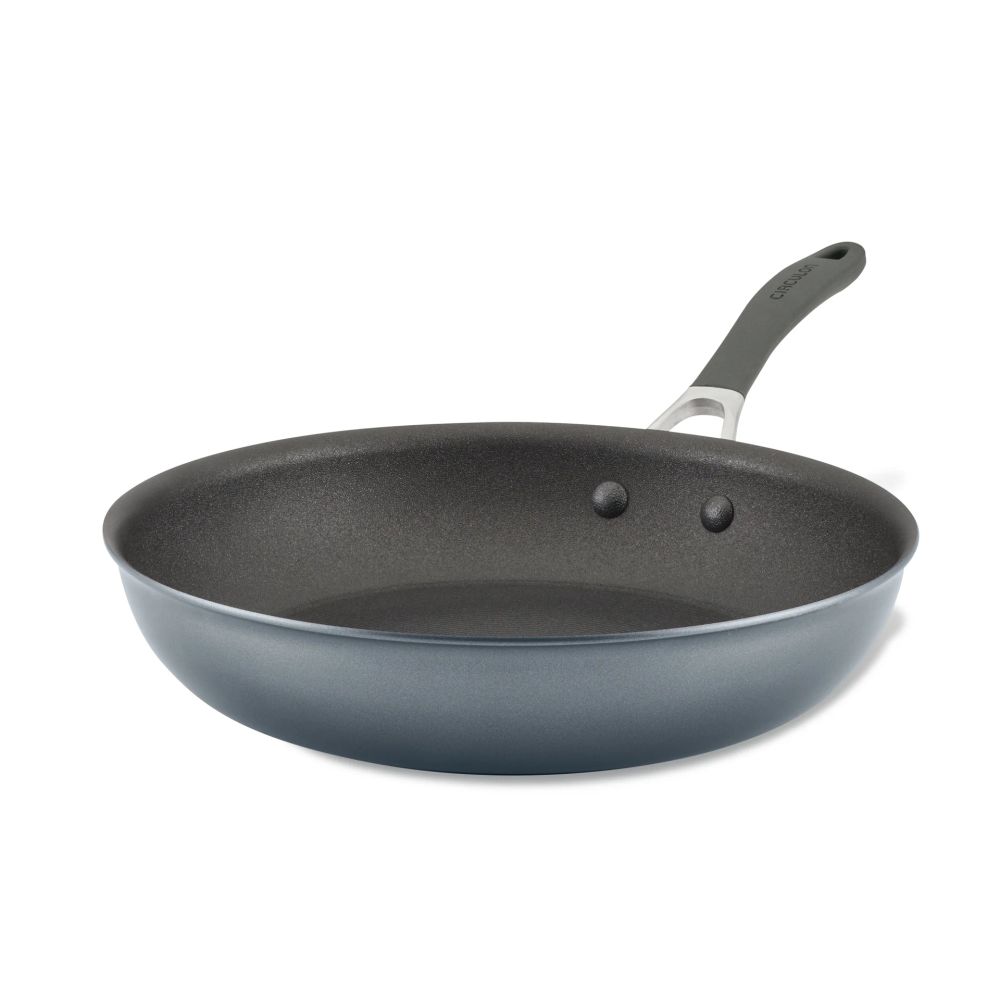
12-Inch ScratchDefense Nonstick Frying Pan
$69.99. The direct price comparator to HexClad's 12-inch pan, with an aluminum core and induction-suitable stainless base.
Shop NowWhat sets Circulon apart is the guarantee behind ScratchDefense. It's a lifetime money-back guarantee, not a defects warranty. If the pan scratches, peels or flakes, the original purchaser gets a refund, provided it was bought from an authorized seller and you cover return shipping. Very little cookware at any price makes a promise that specific about wear.
The constraint is heat, and it varies by line. Circulon's hard-anodized ranges, including the A1 Series, are oven safe to 400°F. The clad C1 Series and the ceramic Halo line go to 500°F. The tempered glass lids are the real ceiling on the A1 set at 350°F, so a lidded braise finishes lower than the pan itself allows. Either way, high-temperature roasting and broiler work are off the table.
Best for: Cooks who want a complete set under $400, who work mostly on the stovetop at low to medium heat, and who want a written promise about scratching rather than a promise about manufacturing defects.
HexClad: The Pan You Can Sear In
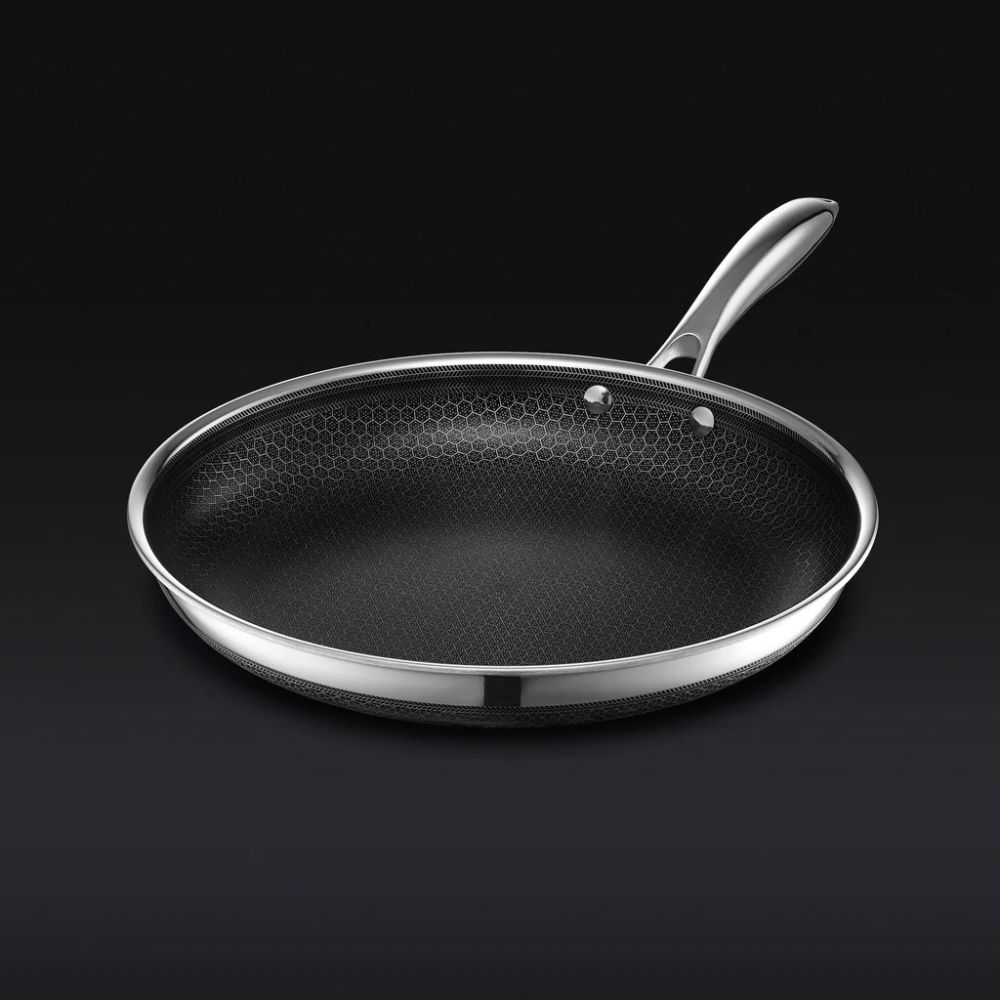
Hybrid Fry Pan, 12-Inch
$179. Tri-ply construction with laser-etched steel hexagons over ceramic nonstick, oven safe to 900°F and metal-utensil safe.
Shop NowHexClad is nine years old and has been in a hurry the whole time. Daniel Winer and Cole Mecray launched it in December 2016, self-funded, and nearly folded inside a year before a Costco in-store demo in November 2017 turned the business around. Gordon Ramsay became an equity partner in 2021, and Studio Ramsay Global, his joint venture with Fox Corporation, put $100 million into the company in July 2024. That growth put HexClad up against most of the modern nonstick field, which we cover in our Caraway vs GreenPan vs HexClad comparison.
The product justifies more of the hype than the marketing does. HexClad describes its build as "hexagonal steel ridges for incredible searing power and durability" with "nonstick valleys containing our proprietary TerraBond ceramic nonstick coating." Underneath, "tri-ply construction features an aluminum core for fast and even heating." The pan is "metal utensil–safe, dishwasher-safe and oven-safe up to 900°F." That 900°F ceiling is more than double what most coated pans allow, and it's the reason a HexClad can go from stovetop sear to broiler without a second thought.
The learning curve is real and worth knowing about before you spend $179 on a single pan. Reviewers consistently report food catching on the raised stainless ridges when the pan goes on cold, because the steel peaks behave like stainless steel and want a preheat and a film of fat. Get that habit right and the nonstick valleys do their job. Skip it and you'll wonder what you paid for.
Pricing runs from $129 for the 8-inch pan to $699 for the 12-piece set, with a 6-piece fry pan set at $399 in between. The lifetime warranty covers manufacturer's defects only. It requires registration, doesn't transfer, and explicitly excludes "damage occurring from improper use, including but not limited to excessive heat, abuse, neglect, improper storage, misuse of sharp utensils, improper cleaning."
Best for: Cooks who sear, roast hot, or finish under the broiler, who use metal utensils by reflex, and who want ceramic nonstick that doesn't feel fragile.
Which One Is Actually PFAS-Free?
HexClad's current cookware is. Most of Circulon's isn't, and Circulon says so on its own site.
Circulon's product disclosures page lists the materials in its fluoropolymer nonstick cookware lines as "Fluoropolymer, PTFE, FEP, PFA (PFAS)" and states plainly: "These products contain intentionally added PFAS because of its superior nonstick properties. Our Fluoropolymer based nonstick coatings are manufactured to comply with FDA and EU regulations for food contact safety standards." That covers the hard-anodized and ScratchDefense ranges, which is most of what Circulon sells.
HexClad's TerraBond coating is ceramic. The brand states it's "free from PTFE and forever chemicals" and reports on its product pages that a third-party lab "tested our pots and pans for PFAS compounds and all results were below the laboratory's detection limit." HexClad's earlier PTFE-based pans were the subject of a California class action, *Cliburn v. One Source to Market, LLC*, over "non-toxic," "PFAS Free" and "PFOA Free" marketing on purchases made between February 2022 and March 2024. HexClad "denied any and all allegations of wrongdoing, fault, liability, or damage of any kind," and the settlement included an agreement to stop using certain advertising statements. The TerraBond switch is what the current range runs on.
If PFAS is your deciding factor but HexClad's pricing isn't workable, Circulon makes a ceramic line. Ceramic coatings behave differently from fluoropolymer ones and wear on a shorter clock, which we get into in our Caraway vs Quince breakdown. Halo with LaserDefense runs $399.99 for ten pieces. Circulon says it's "6x more stain resistant, 9x more scratch resistant, and has 50% longer-lasting nonstick release than the ceramic nonstick competition." That figure is footnoted to the brand's own food-release testing at 430°F and staining tests at 390°F. Halo is also oven safe to 500°F, a full 100 degrees above Circulon's hard-anodized ranges.
Does the Price Gap Hold Up?
Per piece, HexClad costs roughly two and a half times what Circulon does. A 12-inch pan is $179 against $69.99. Twelve HexClad pieces are $699 against $329.99 for ten Circulon pieces. That is not a rounding error.
The usual defense of a premium pan is that it lasts longer, so it's cheaper per year. That argument is weaker here than it looks. Circulon is the brand offering a lifetime money-back guarantee against the failure mode that kills nonstick pans, while HexClad's warranty covers manufacturing defects and excludes wear. On paper, the cheaper brand is carrying more of the durability risk.
Where HexClad's price earns itself back is capability rather than lifespan. A 900°F ceiling, a searing surface, and genuine metal-utensil tolerance let one pan replace both a nonstick skillet and a stainless one. If you were going to own both anyway, the gap narrows fast.
Which Should You Buy?
Route this by what you cook, not by what you want to spend.
Buy Circulon if your cooking lives on the stovetop and stays under 400°F in the oven. Eggs, pancakes, fish, weeknight sautés and braises are exactly what the raised-circle surface is for, and $329.99 buys ten matched pieces.
Buy HexClad if you sear steaks, roast at high heat, finish things under the broiler, or reach for metal utensils without thinking. The 12-inch pan at $179 is the honest entry point, and plenty of kitchens run on that one pan.
Buy Circulon Halo if avoiding PFAS is the priority and $699 isn't happening. It's ceramic, it's $399.99 for ten pieces, and it keeps you inside one brand's warranty system. For more options in that category, see our roundup of brands like Caraway for non-toxic cookware.
Five Things to Know Before You Choose
The oven ceiling is the real dividing line
Circulon's hard-anodized lines are oven safe to 400°F, its clad and ceramic lines to 500°F, and its glass lids to 350°F. HexClad is rated to 900°F throughout. If you roast hot or use the broiler, this spec decides the comparison before price enters into it.
Read the two warranties as different promises
HexClad's lifetime warranty covers manufacturer's defects and excludes wear. Circulon's ScratchDefense guarantee refunds you if the surface scratches, peels or flakes. One protects against a bad pan, the other against a worn one.
Circulon publishes its PFAS position, so check which line you're buying
The fluoropolymer ranges contain intentionally added PFAS by Circulon's own disclosure. Halo with LaserDefense is the ceramic alternative at $399.99 for ten pieces.
HexClad needs a preheat
Reviewers consistently report sticking on the stainless hexagons when the pan starts cold. Bring it up on medium, add fat, then cook. The habit takes a week and the pan behaves after that.
Buy the pan before the set
A single [HexClad 12-inch pan](https://hexclad.com/products/12-hexclad-pan) is $179 and a [Circulon 12-inch pan](https://circulon.com/products/scratch-defense-12-inch-nonstick-frying-pan) is $69.99. Both brands sell the individual pan that does 80% of the work, which is a cheaper way to find out whether the surface suits you than committing to a set.
Frequently Asked Questions
Is HexClad worth the extra money over Circulon?
HexClad is worth it if you cook above 400°F. Its 900°F oven rating and searing surface let one pan do the work of a nonstick skillet and a stainless one. If your cooking is mostly stovetop and moderate heat, Circulon delivers the same everyday food release for around 40% of the price, and a full 10-piece set costs less than two HexClad pans.
Is Circulon cookware PFAS-free?
Most Circulon cookware is not. Circulon's own product disclosures state that its fluoropolymer nonstick lines "contain intentionally added PFAS because of its superior nonstick properties," listing PTFE, FEP and PFA among the materials. The exception is Halo with LaserDefense ($399.99 for ten pieces), which is a ceramic coating rather than a fluoropolymer one.
Can you use metal utensils on Circulon and HexClad?
Yes on both, with a caveat. HexClad is metal-utensil safe by design, because the raised steel hexagons take the contact instead of the coating. Circulon's ScratchDefense lines are also rated for metal utensils and backed by a money-back guarantee against scratching. Circulon's older hard-anodized ranges are more conventional nonstick and last longer with silicone or wood.
What temperature can Circulon and HexClad go in the oven?
It depends on the Circulon line. Its hard-anodized ranges, including the A1 Series, are oven safe to 400°F, while the clad C1 Series and the ceramic Halo line reach 500°F. The tempered glass lids cap out at 350°F. HexClad is oven safe to 900°F. That gap rules Circulon out for high-temperature roasting and broiler finishing. Both brands are induction compatible and dishwasher safe.
Which lasts longer, Circulon or HexClad?
Neither brand publishes an independent lifespan figure, so compare the guarantees instead. Circulon says ScratchDefense "lasts 130X longer than the competition" in its own lab testing and backs it with a lifetime money-back guarantee against scratching, peeling and flaking. HexClad offers a lifetime warranty against manufacturer's defects that excludes normal wear, though its steel hexagons carry utensil contact that would otherwise reach the coating.
Is HexClad's nonstick still PTFE?
No. HexClad's current cookware uses a proprietary ceramic coating called TerraBond. The brand describes it as "free from PTFE and forever chemicals" and reports it testing below a third-party laboratory's detection limit for PFAS compounds. Earlier HexClad pans used PTFE, and marketing claims about those products were the subject of a California class action that HexClad denied and later settled.
